

Bhutanese Painting
Symbols of longevity and hope illuminate the National Mall
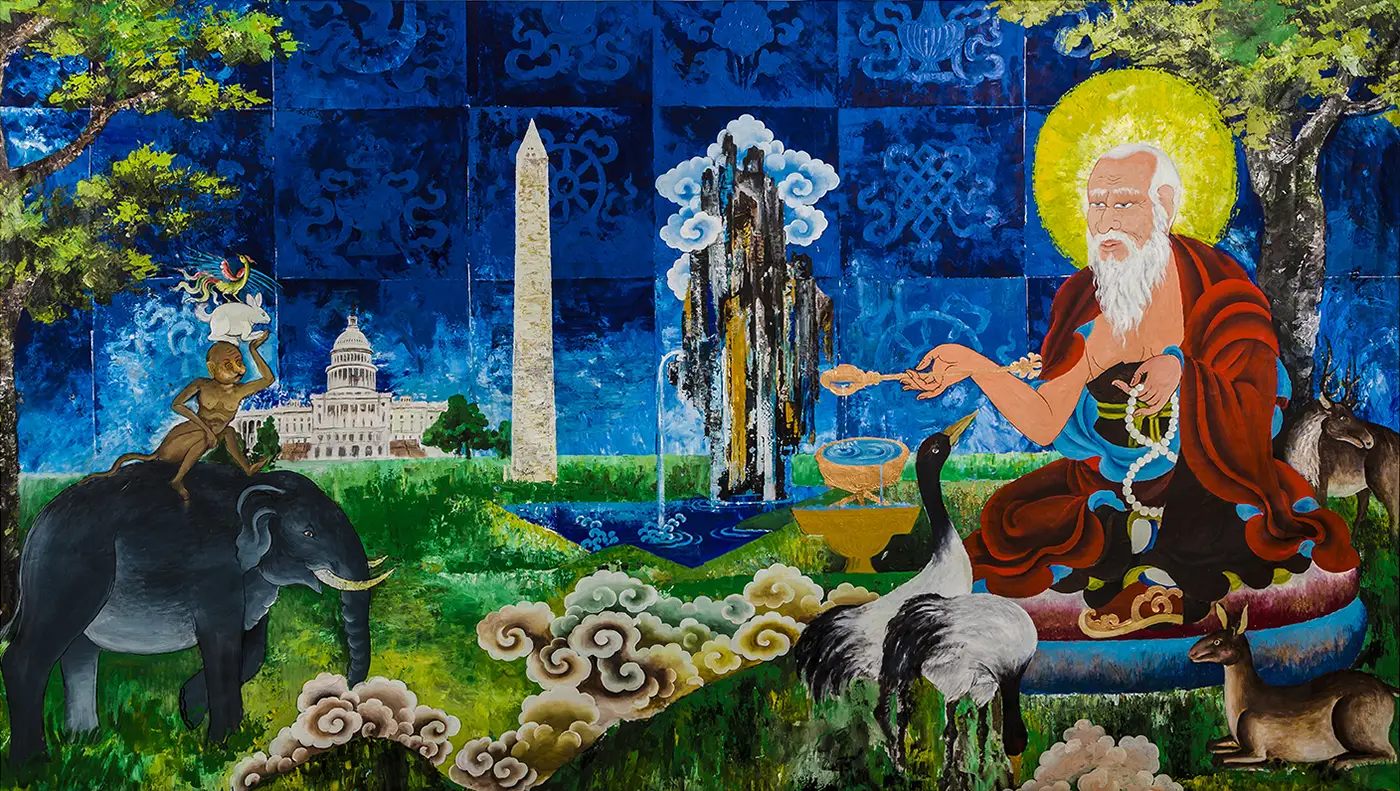
Kama Wangdi still carries fond memories of his time participating in the 2008 Folklife Festival. He recalls the “talks, laughs, and discussions” with the many people who stopped by his tent. He reminisced that he worked to imbue the positive energy he felt from these interactions into the painting, and noted that Bhutanese art, especially paintings, carry “harbingers of hope,” which he expressed by weaving three offerings of blessings into the composition to “guide our happiness and self-realization through unity and harmony.” The blessings are embodied by the Six Longevities, Four Harmonious Friends, and Eight Auspicious Symbols. He named the painting: “Three Offerings of Blessings to the United States.”
At five feet high and nine feet long, the painting now hangs in a long hallway at the Center for Folklife and Cultural Heritage. Passersby are drawn into the composition at eye level, first encountering the ancient Recluse, a Buddhist sage who manifests longevity in harmony with nature. He is surrounded by significant flora, fauna, and geologic features that combine to represent the Six Longevities. The Washington Monument and Capitol Building share middle ground with the Immutable Rock of Longevity which spouts pure, restorative water. The Four Harmonious Friends on the far left and Eight Auspicious Symbols (visible in the blue squares in the sky) complete the blessings.
-
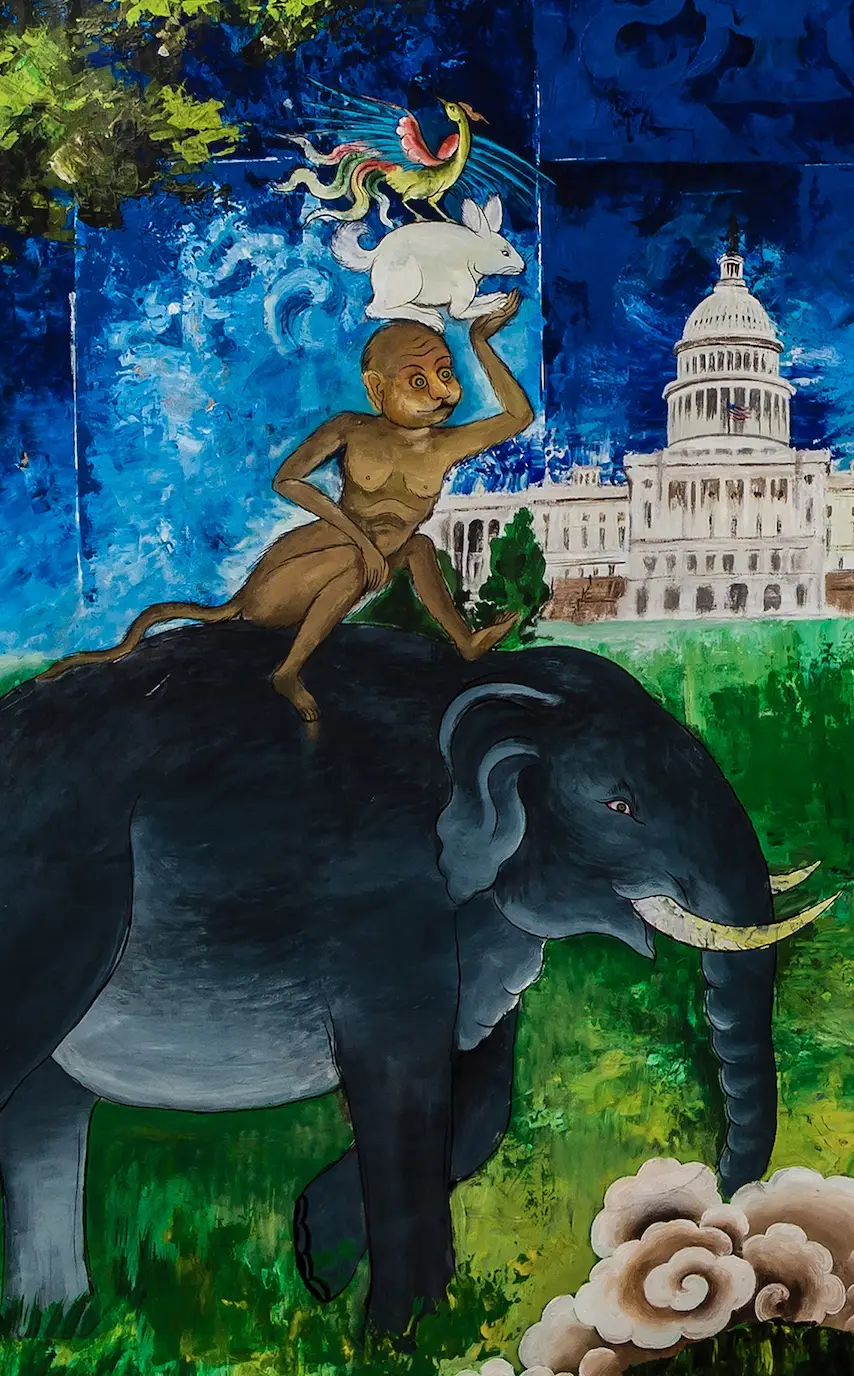
Detail. Photo by Zvonimir Bebek, Ralph Rinzler Folklife Archives
The Four Harmonious Friends are drawn from a popular Bhutanese tale about the value of cooperation. In the version recounted by co-curator Preston Scott, the peacock finds and plants a seed, which is watered by the rabbit, then fertilized by the monkey. After the seed sprouts and the young plant starts to grow into a tree, the elephant protects it. Once the tree matures, however, the fruit is too high to be reached by any of the four animals. By standing on top of each other and combining their strengths, they are all able to reach the fruit and enjoy the reward of their cooperation.
