


Calligraphy Painting
“When I was a child, I would wake up early every morning to watch the sunrise and stay up in the evening to admire the sunset. The vivid blend of hues and tones ignited a love for art in me. I prayed to God to make me an artist.”
Creativity and concentration invite quiet observation
-
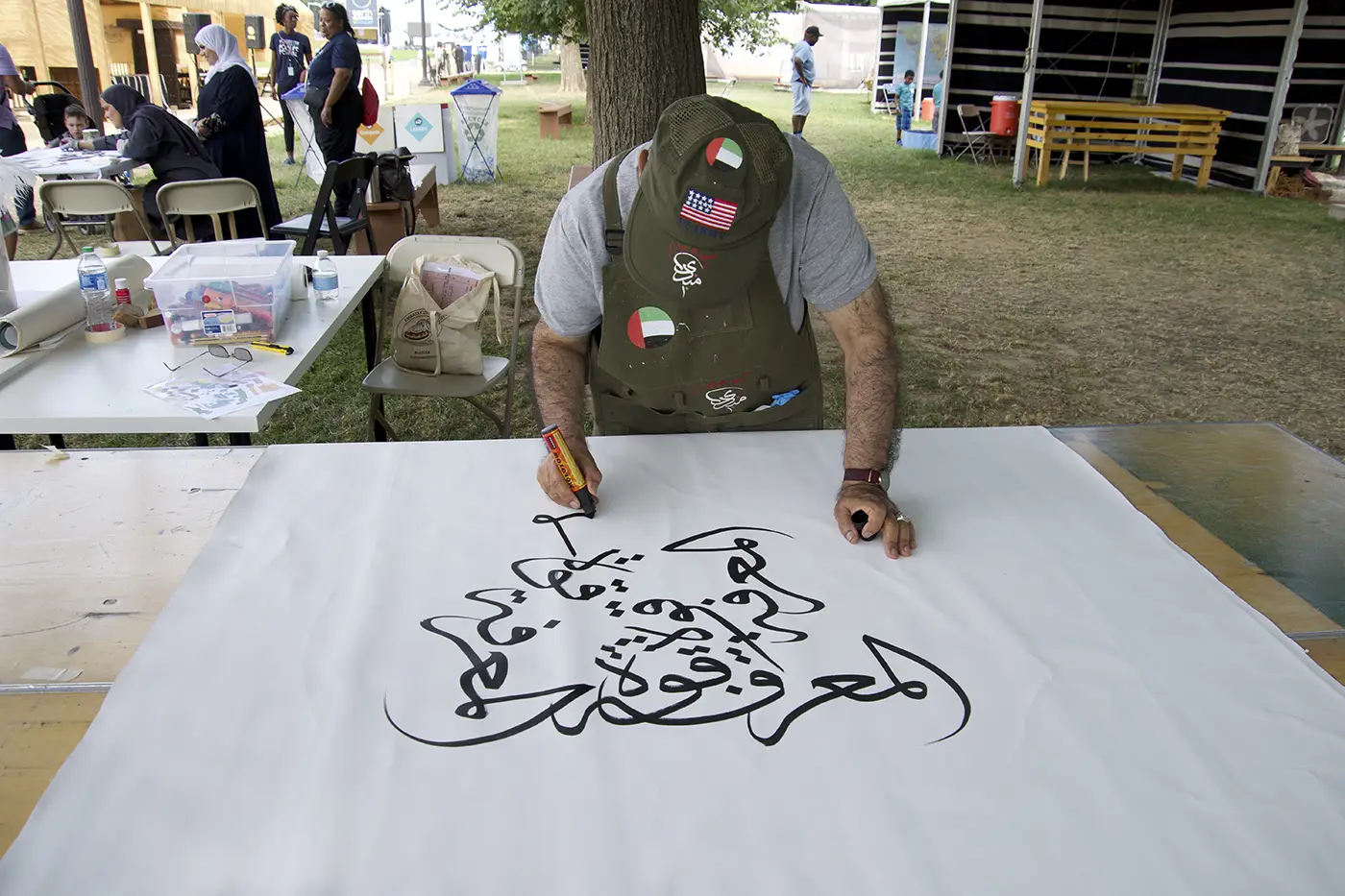
Mohammed Mandi begings works on the calligraphy. Photo by Stanley Turk, Ralph Rinzler Folklife Archives -
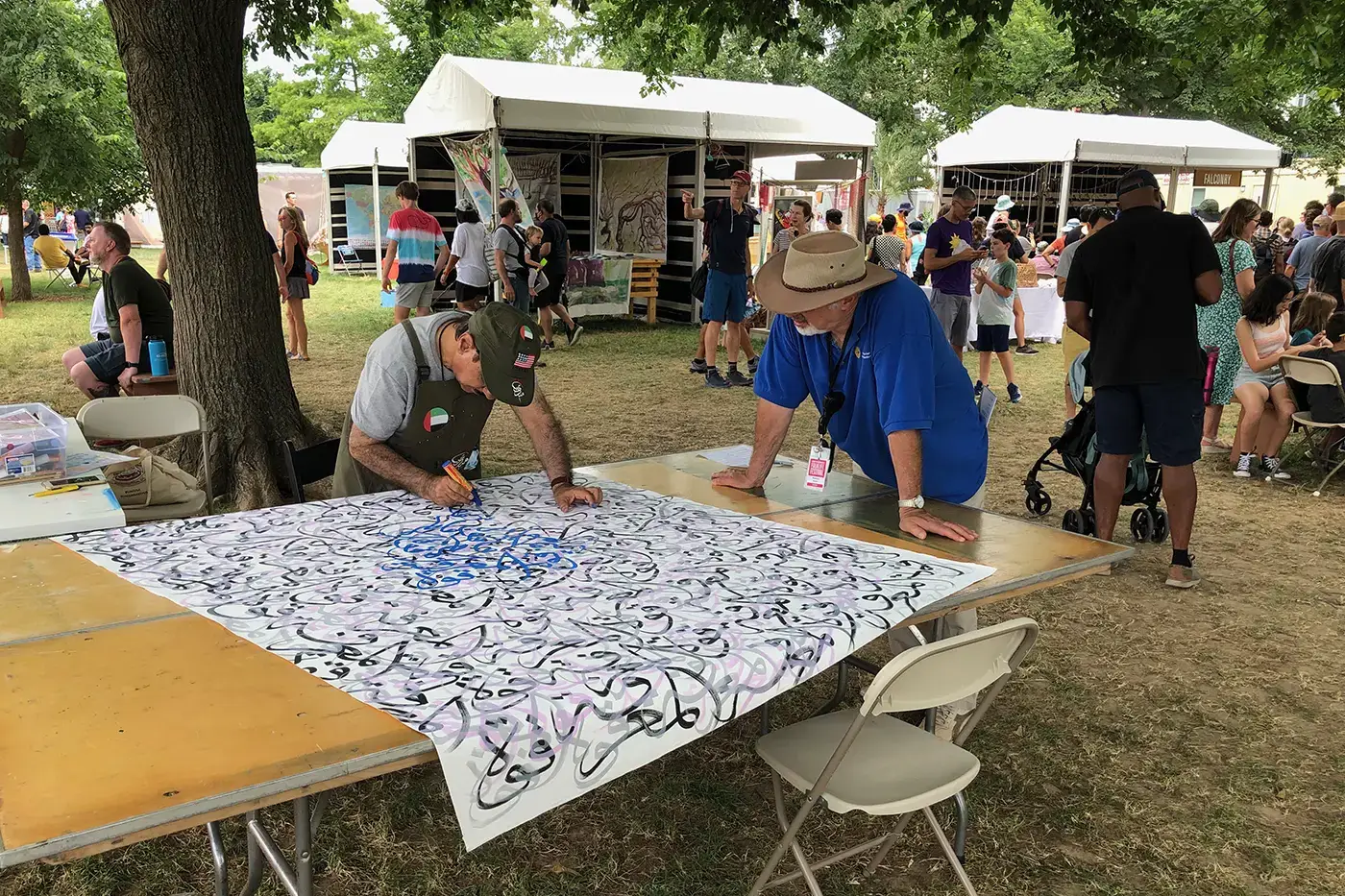
Mandi concentrates under observation and works on the calligraphy throughout the Festival. Photo by Erin Younger, Ralph Rinzler Folklife Archives -

On the last day, he donates the finished painting to Festival director Sabrina Lynn Motley Photo by Sonya Pencheva, Ralph Rinzler Folklife Archives
In spite of summer heat and the excitement around him, calligrapher Mohammed Mandi maintains incredible focus on his work; he is so immersed in each stroke that the movements begin to absorb him. The observer is also far from passive, entranced by the creative process unfolding in front of him. For days, 2022 Festival guests were hypnotized by the rhythmic ebb and flow involved in creating this piece, and they paused often around Mandi’s table to watch his repetitive sweep of motions until the painting was complete.
The Arabic script reads “Knowledge is power,” a famous quote by Francis Bacon, the sixteenth-century English philosopher and statesman known for his contributions to natural philosophy and modern science. In choosing this quote, Mandi conveyed the importance of knowledge as a valuable force for humanity—often more powerful than physical strength. The script begins in the center of the painting and radiates outward, unfolding layer upon layer, until it becomes a dynamic spiral harmoniously reflecting the powerful message.
-

Mandi’s signature in silver, lower left corner. Photo by Sonya Pencheva, Ralph Rinzler Folklife Archives
Calligraphy has captivated onlookers for thousands of years, reflecting what can be an ordinary text in an imaginative manner. This art form is not limited to its visual appeal but can also carry a divine layer of meaning in the religion of Islam. The Holy Quran—the central scripture of Islam—was revealed in Arabic and is considered to be the direct word of God. Arabic script thus retains a sort of divine status as the expression of God’s revelation. Festival visitors may have been drawn to Mandi’s work table by the dynamism of his design and intensity of his concentration, but, before they left, they also learned something about Islamic art and civilization.
