

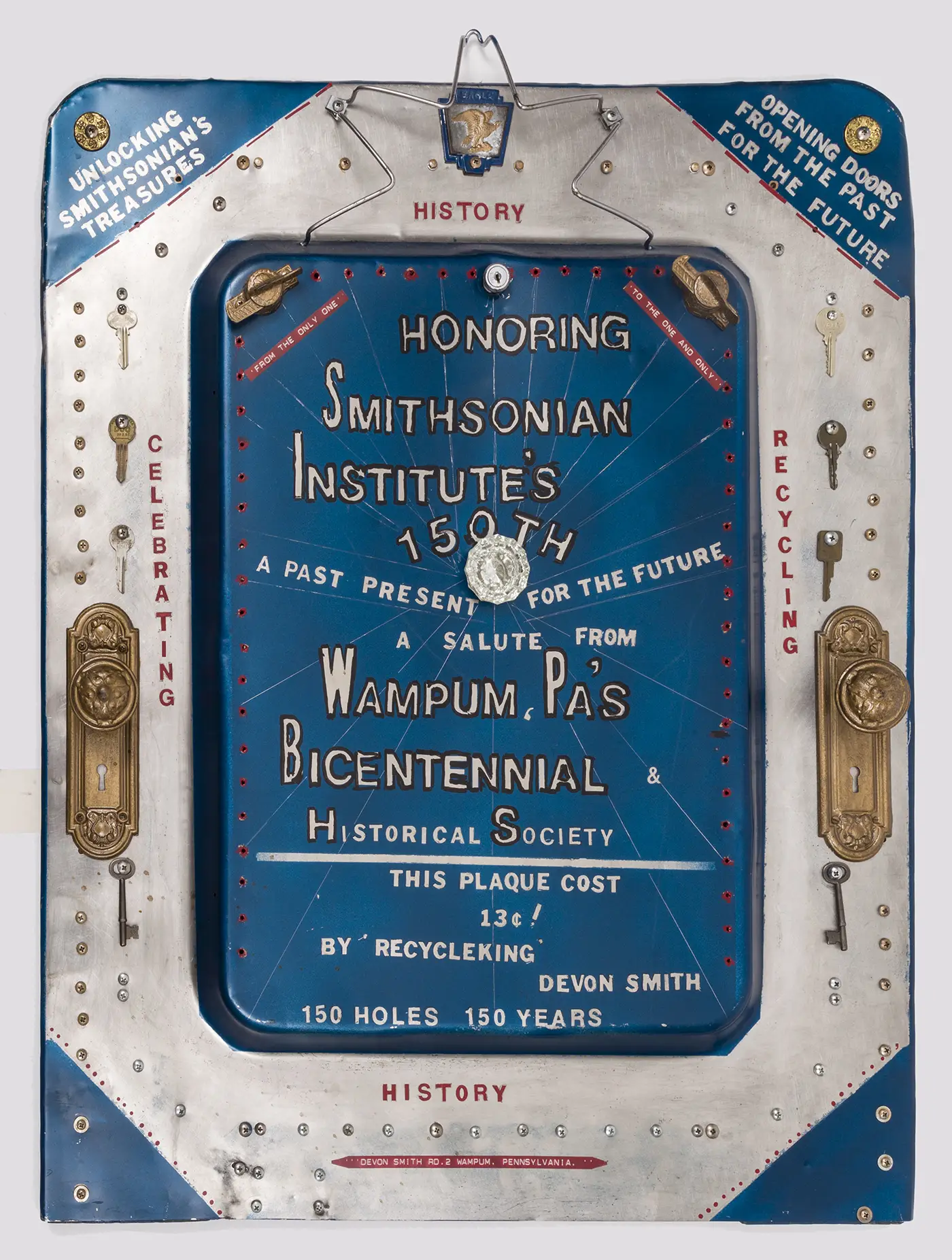
150th Anniversary Plaque
A foray into producing special events
August 10, 1846, was an eventful day in Washington, D.C. The U.S. Congress enacted legislation to establish the Smithsonian Institution, and President James K. Polk signed the bill that same day. The Institution’s centennial in August 1946 saw only a small exhibition inside the National Museum of Natural History, so hopes were high for something bigger to mark the sesquicentennial in 1996.
Many Smithsonian staffers were initially unenthusiastic. It would be terribly hot in August, Congress would be in recess, and it would cost a lot of money. Nevertheless, the Center for Folklife and Cultural Heritage, which already had some thirty years’ experience producing the Folklife Festival, agreed to take on the task. Since the early 1990s, the Center has produced a number of large-scale special events: America’s Reunion on the Mall in conjunction with President Bill Clinton’s 1993 inauguration; Southern Crossroads: A Festival of the American South celebrating the 1996 Olympic Games in Atlanta; National World War II Reunion in honor of the National World War II Memorial dedication in 2004; First Americans Festival concurring with the National Museum of the American Indian opening in 2004; and Freedom Sounds: A Community Celebration for the opening of the National Museum of African American History and Culture in 2016.
Among the gifts received by the Smithsonian for its 150th birthday was this commemorative plaque, created by DeVon Smith (1926–2003) of Wampum, Pennsylvania, which coincidentally was celebrating its bicentennial in 1996. Smith was born five miles from Wampum and served in the U.S. Army during WWII. In 1947, he began a career of professional hitchhiking. He set records for the fastest time to hitch in all 48 states (33 days) and for the most cumulative miles (290,980). In the 1970s, he returned to Wampum, where he bought and sold scavenged items—such as the materials for this plaque, which cost Smith a total of 13 cents. Painted on the plaque are the words, “Opening doors from the past for the future,” which pay tribute not only to the Smithsonian, but also to Smith’s own creative spirit.
