

Herbalist Elizabeth Beamon’s Quest for Simple Living

Photo by Anna Beth Lee, Ralph Rinzler Folklife Archives
Elizabeth Beamon wants herbalism to look easy.
Herbalism is the practice of using plants alongside technique to heal the body and promote wellness through botanical knowledge. It’s not just teas and tinctures but pots of delicious soup, full of the plant medicine your body needs to recover after a cold. While most of us might find it daunting to preserve, harvest and can food in our own backyard, Beamon has been using these practices throughout her youth. Her passion for this work is driven by her belief that herbalism is a ritual.
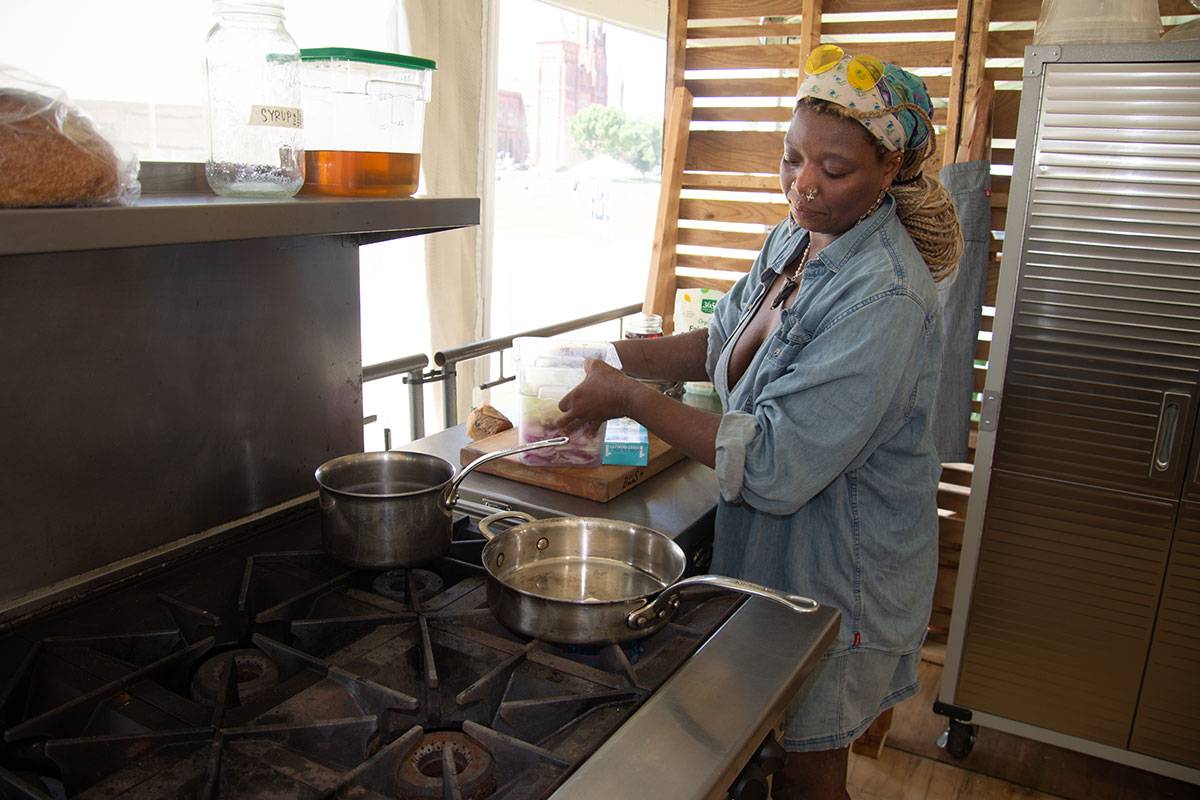
At the 2025 Smithsonian Folklife Festival, Beamon demonstrated both cooking and pressure canning. While making her French onion mushroom soup, she discussed the importance of cooking for health, nutrition, and preventing ailments through food. Using the finished soup as an example, she taught Festival visitors how to can goods with or without a pressure canner.
Beamon is the younger half of one of the apprenticeship teams in the Virginia Humanities Folklife Program’s 2024 Virginia Folklife Apprenticeship. Her mentor, Leni Sorenson, is a food historian, teacher, chef, and farmsteader. Their work together focuses on traditional Virginia foodways and historical homesteading practices within the African American community. Their projects include gardening, canning, preservation, outdoor cooking, and hosting historical dinners.
Beamon learns and shares valuable skills and traditions from Sorenson and then uses her apprenticeship to deepen her work as an herbalist. Herbalism and plant medicine have guided Beamon’s vision for her future looking forward.
When Beamon came off the Festival Foodways stage, I had the chance to sit in the grass on the National Mall and speak with her about herbalism, cooking, and what it means to be a young person learning traditional sustainable practices from an elder in their community.
“I think my work contributes to reigniting a passion for simplicity, a passion for home-based activity, and for a desire to nurture each other, our bodies, our minds, thoughts, free thought, free movement,” Beamon said. “I want people to feel like they have the skills to survive in or out of the dominant social schema. Start a garden, figure s*** out, and live a happy, healthy life, full of curiosity and intellectual thought.”
Beamon’s practice of herbalism expanded into bartending, creating innovative and delicious tonics for cocktails at her local Korean bar. This kind of work brought herbalism and her culinary experience together. The more she worked on drinks, the more she discovered how plant medicine can be incorporated into culinary work of all kinds. As a person who lives with chronic illness, Beamon explained how she has also used her knowledge and practice as medicine.
“I have had pretty rough eczema my whole life,” she said. “For my health and for my sanity, it’s just a beautiful practice. What’s better than rummaging through a big medicinal garden? Digging for echinacea root, digging for dandelion root, or cutting milky oats.”
Beamon and I discussed our own experiences with sensitive skin and allergies, recalling times that simple remedies were the most helpful, like aloe or natural salves. Understanding how to make these things has shifted her perspective, and learning from Sorenson has shaped much of her understanding of her own commitment to her personal herbalist practice.
I asked Beamon, what does it mean to be a knowledge keeper, or to bear the responsibility of passing on cultural practice? Beamon detailed her relationship with Black Elders who have inspired her, citing Sorenson and the writings of Toni Morrison. Morrison is renowned for incorporating themes of the natural environment alongside her stories of Black femme identity and belonging. Beamon’s commitment to her own intellectual enrichment from a writer such as Morrison has been crucial to her own sense of culinary proficiency. These stories also hold lessons, techniques, and ways of living about her community that Beamon can relate to and see herself in. It has been essential for Beamon to pay attention to those who have done the work to record African American tradition.
“Culinary historians, historians of all types, are super important because they have the information that we have lost in a lot of ways in cultural practice,” Beamon explained. “People don’t know what to do when the lights go out. They don’t know how to make a candle. These are the things that are about to be very important for people to live well and to live free.”
Black women have played a key part in American culinary history, including traditions in homesteading and herbalism. As homesteading becomes more popular through social media, Beamon is curious about their perceptions of who practices herbalism.
“I think people are afraid of herbs because of the ‘wise woman,’ because of a certain idea of who is an herbalist and who is not,” she said. “And so for me, it’s about demystifying. Then I think there’s a certain personage. People don’t look at Black women and think, ‘Oh, this person knows a lot about tinctures or a lot about salves.’ But I would argue, in the U.S., no one knows more. This is our inheritance, and it is our tradition. So it’s for all of us. And that’s really what my goal and my point is, to make it for all of us again.”
Part of that goal is making what she’s learned and what she knows look simpler. Plenty of the traditions, culinary techniques, and gardening strategies come from a simple routine. While a skill like canning is meticulous, it typically requires only a few clear steps.
“I want someone to look at what I do and go, oh, this s**** easy. I want it to look easy. I want it to be like, oh, I can totally do that. Maybe it’s not easy labor, no, but it’s simple practice. You can spend days canning a full garden, and it’s labor. It’s a lot of lifting, it’s a lot of heat, it’s a lot of intention. But they’re simple, and I think I’m not alone in being someone who longs for simplicity in the modern era, you know? I want it to be simple. I want people to be able to live simple lives.”

When I asked Beamon how it feels to take what she learned about herbalism and reinterpret it as a young person, she spoke to the ways in which herbalism has evolved—and is still evolving as science advances.
“The way that we can extract something in its purest form is not just by putting it in a jar and covering it anymore. It’s actually by titrating it,” Beamon gave as an example. “There are things that we know now as young people that we can develop further. I think that’s really wonderful. When I think about the future and being a young person in this game, I’m like, oh, we have the time, and we have the science behind us. Maybe an unpopular word, but science. I think that that’s what it is for a lot of people, especially in food.”
Many of these practices also hold a spiritual and habitual connection for Beamon. As we talked, Stax Music Academy’s vocal instructor, Leah Buckley, began singing nearby, leading a gospel workshop in the Music Apprenticeship program area. Beamon then told me about how herbalism is more than just practice, but a practice of faith.
“Herbalism is part ritual,” Beamon said. “I think the ritual and the practice of it is protective, whether it is in a spiritual sense or not. I think there are certain things that keep communities whole, and it is shared faith. And it doesn’t have to be in God, but it could be in protecting yourself with rosewater. There are practices that—and that are often land-based, too—which I really think are important practices in your home.”
Ritual, tradition, and cultural heritage are at the core of Beamon’s work. Young people across the United States are learning what it means to sustain their own cultural traditions and shape them into their own. I asked Beamon what it means to her to be doing this work.
“[Doing the work means] to be Black and alive and growing into the traditions of my ancestors,” she replied, “and to try to hold those traditions while also forging new paths, especially in the face of incredible difficulty and eventual suffering that happens when you don’t have certain programs and certain practices in public health etc.” She has taken her family’s traditions and shaped them with science, ritual, and knowledge from the mentors of her life.

Lirit Gilmore is the foodways coordinator for the Smithsonian Folklife Festival.
